 Home Loans
 Personal Loans
 SME Loans
 Business Loans - Udyog Plus
  Loan Against Securites
 Loan Against Property
 Mutual Fund
 Stock and Securities
 Wealth
 Portfolio Management Services
 Pension Funds
 Life Insurance
 Health Insurance
 Wellness Solutions
 Pay Bills
 Pay for anything
 Pay Anyone
 Pay on Call
 Credit Cards
 Prepaid Gift Card



 1800-270-7000
-
Our Products
-
Self Care
- Downloads
- Learnings
- About Us
-
More
-
Shareholders
-
Shareholders
-
-
SIP Calculators

-
Shareholders




 IMPORTANT ALERT ! Beware of Fake AMC App, Online Impersonation & Scam WhatsApp Groups.
ABC Solution 
Loans
Insurance


 AppStore
 Playstore
Aditya Birla Sun Life AMC Limited
Aditya Birla Sun Life AMC Limited

Goal-Based Investing with Flexi Cap Fund

Mar 26, 2026
5 min
0 Rating
Flexi-cap funds can support goal-based investing by offering diversified equity exposure across market caps and adapting allocations depending on market conditions.
Getting Started with Goal-Based Investing
Investing without a clear goal can make financial planning difficult. Goal-based investing focuses on aligning investments with specific financial objectives such as education, retirement, or wealth creation.
In India, mutual funds have become an important tool for goal planning. The category of flexi cap mutual funds alone crossed ₹5.45 lakh crore in assets under management (AUM) in 2025, making it one of the largest equity fund segments in the country, according to AMFI.
The growth of this category reflects increasing investor confidence in funds that can adapt across different market conditions. For investors building long-term strategies, a flexi cap fund may be considered as part of a diversified portfolio within a goal-based investing approach.
Why Asset Allocation Matters for Financial Goals?
Different financial goals require different investment approaches. For example:
Short-term goals may require lower volatility.
Medium-term goals may benefit from balanced risk.
Long-term goals may require exposure to growth-oriented assets like equities.
Asset allocation plays a key role in achieving this balance. By spreading investments across asset classes and market segments, investors can manage risk while aiming for long-term capital appreciation depending on market conditions.
In equity investing, flexi-cap mutual funds are designed to provide diversification across companies of different sizes, which may help manage market fluctuations over time.
What Is a Flexi Cap Fund?
It is an equity mutual fund that can invest across mid-cap, large-cap, and small-cap companies without fixed allocation limits.
Unlike some other equity categories that require a specific percentage in certain market caps, flexi cap funds give fund managers the flexibility to adjust allocations based on market opportunities.
This structure allows flexi cap mutual funds to:
Invest in established large companies for stability
Identify growth opportunities in mid-sized companies
Capture potential expansion in smaller companies
Because of this flexibility, many investors use flexi cap funds as a core component of their equity allocation within goal-based investing strategies.
How Flexi Cap Funds Adapt Across Market Cycles?
Markets often move through different phases, such as growth, correction, and consolidation. A key feature of flexi cap funds is their ability to adjust allocations depending on market conditions.
For example:
During uncertain periods, fund managers may increase exposure to large-cap companies that are generally considered relatively stable.
In growth phases, allocations may shift toward mid-cap or small-cap companies where expansion potential may be higher.
This flexibility is one reason why flexi cap mutual funds have grown by 148.28% in India, with AUM increasing from about ₹2.22 lakh crore in 2021 to over ₹5.52 lakh crore by 2025, according to ICRA Analytics.
However, outcomes from such allocation decisions can vary depending on market conditions.
Matching Flexi Cap Funds to Short, Medium, and Long-Term Goals
A flexi cap fund can potentially support different types of financial goals depending on the investment horizon.
Short-Term Goals
Short-term goals are often considered those that may arise within about three years, such as building an emergency fund or planning a near-term purchase.
Medium-Term Goals
Medium-term goals may typically fall in the three to five-year range. Examples may include saving for higher education or making a large purchase in the coming years.
Long-Term Goals
Long-term goals are generally considered those with a time horizon of five years or more, such as retirement planning or long-term wealth creation. Over longer periods, equity investments may have more time to navigate market cycles depending on market conditions.
Investors exploring options such as the Aditya Birla Flexi Cap Fund may evaluate how such funds align with their broader financial planning objectives.
How Can SIP Work for Goal Planning?
A systematic investment plan (SIP) is a disciplined method of investing a fixed amount regularly in mutual funds.
SIPs are widely used in goal-based investing because they allow investors to build investments gradually over time.
Some potential benefits of SIPs include:
Consistency: Regular investments help build long-term discipline.
Cost averaging: Investing periodically may help average purchase costs over time, depending on market movements.
Accessibility: Investors can start with relatively small amounts and increase investments gradually.
As SIP participation has grown in India, it has played a major role in supporting long-term mutual fund investments across different categories.
What are the Risks with Flexi Cap Mutual Funds?
Like all equity investments, flexi cap mutual funds carry certain risks that investors should consider.
Market Risk: Equity markets can fluctuate due to economic, political, or global factors.
Allocation Risk: Since fund managers can shift allocations across market caps, the portfolio's risk profile may change with market conditions.
Manager Strategy Risk: The performance of flexi-cap funds depends significantly on investment decisions and stock selection.
Because of these factors, investors should assess their financial goals, investment horizon, and risk tolerance before investing in a flexi cap fund.
Building Long-Term Financial Goals with Flexi Cap Funds
Goal-based investing is not just about selecting investments; it is about aligning them with life objectives.
Flexi-cap funds offer flexibility to invest across different segments of the equity market, potentially enhancing diversification within an investment portfolio. Their ability to adjust allocations across large, mid, and small companies allows them to respond to changing market conditions.
For investors planning long-term financial goals, including retirement or wealth accumulation, flexi-cap mutual funds can be considered as one component within a broader strategy.
Evaluating options such as the Aditya Birla Flexi Cap Fund may help investors explore diversified equity exposure while aligning investments with clearly defined financial goals.
Disclaimers:
The information herein is meant only for general reading purposes and the views being expressed only constitute opinions and therefore cannot be considered as guidelines, recommendations or as a professional guide for the readers. The document has been prepared on the basis of publicly available information, internally developed data and other sources believed to be reliable. Recipients of this information are advised to rely on their own analysis, interpretations & investigations. Readers are also advised to seek independent professional advice in order to arrive at an informed investment decision.
SIP does not assure a profit or guarantee protection against loss in a declining market.
Source:
https://www.financialexpress.com/money/investors-bet-big-on-flexi-cap-funds-in-2025-rs-5-lakh-crore-assets-the-only-equity-category-to-do-so-4082036/#:~:text=To%20Do%20So-,Investors%20bet%20big%20on%20flexi%2Dcap%20funds%20in%202025%3A%20Rs%205%20lakh%20
https://economictimes.indiatimes.com/mf/mf-news/resilience-in-volatile-market-and-strong-track-record-keep-flexi-cap-mutual-funds-in-focus-icra-analytics/articleshow/126765281.cms?from=mdr#:~:text=funds%20are%20witnessing%20strong%20growth%20in%20India%2
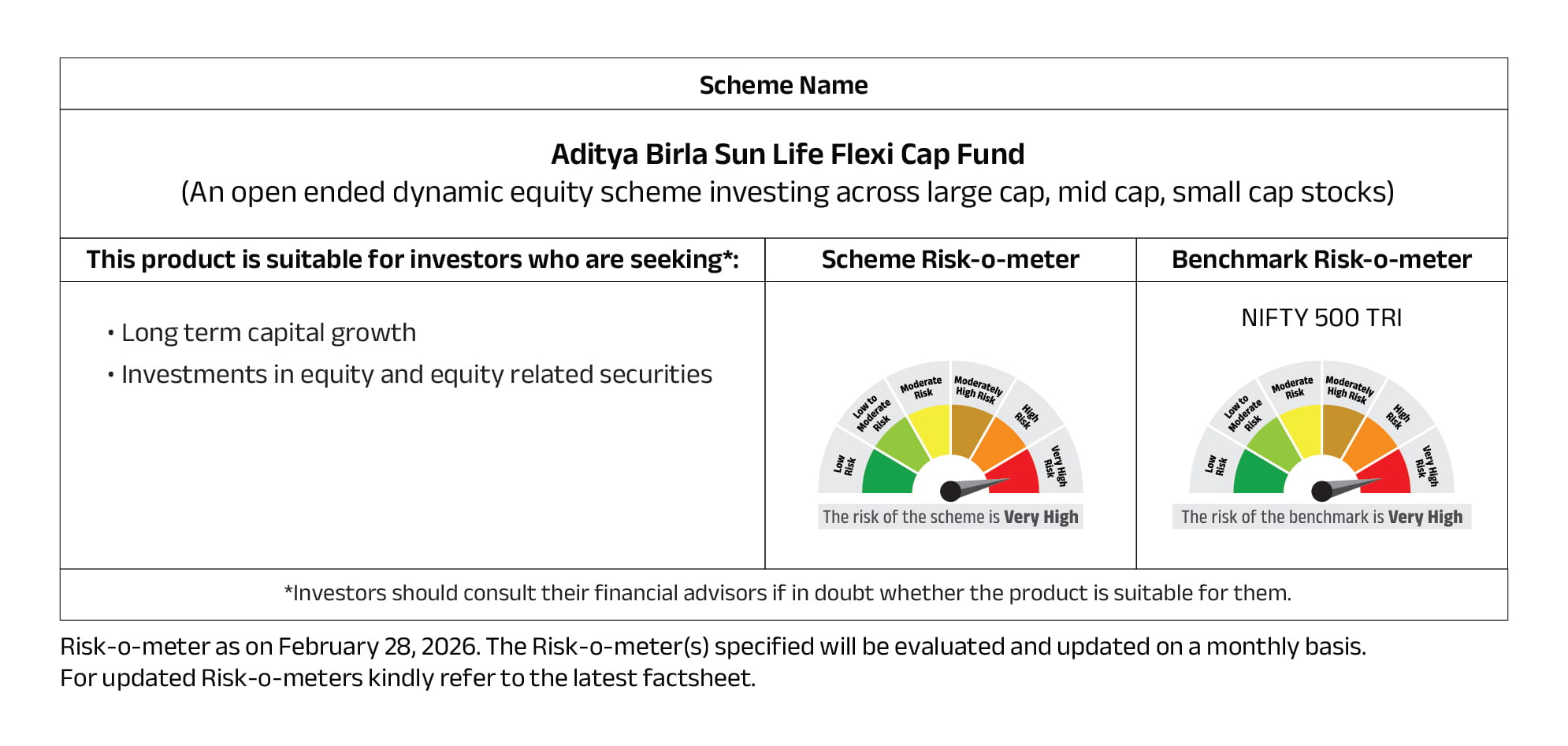
Mutual Fund investments are subject to market risks, read all scheme related documents carefully.

Flexi cap funds are often considered for long-term investing because they invest across multiple market segments, though outcomes depend on market conditions.
Fund managers can shift allocations across large-cap, mid-cap, and small-cap stocks depending on market conditions.
They may be considered as part of a diversified portfolio for retirement planning, depending on an investor’s time horizon and risk tolerance.
Flexi cap funds are generally considered for medium- to long-term investment horizons, often five years or more.
SIPs help investors invest regularly and gradually build investments over time while aligning contributions with financial goals.